Media Library
Every image you upload lands here, already converted. The library is a grid, but the useful part is the strip of numbers above it.
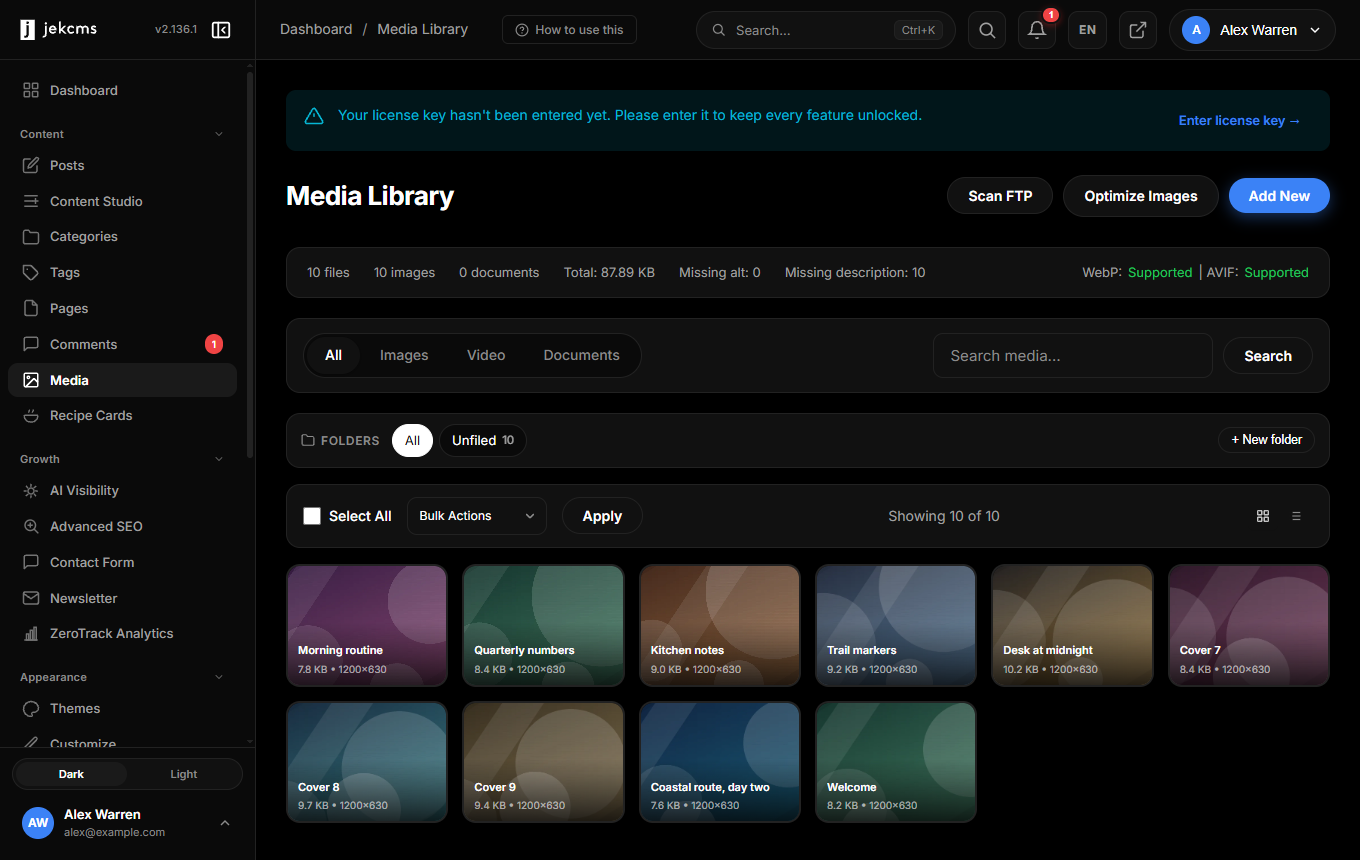
Read the top strip first
It tells you how many files you have, how much disk they take, and - the two that matter - how many are missing alt text and how many are missing a description.
Alt text is not decoration. It is what a screen reader announces and what search engines read when they cannot see the picture. A library with forty images and forty missing alt texts is forty small SEO holes. The counter is there so the number goes down instead of being forgotten.
The strip also states plainly whether WebP and AVIF are supported on your server. If either says otherwise, that is a PHP extension question for your host, not a setting you can fix here.
What happens when you upload
jekcms converts on the way in rather than serving what you gave it. An upload becomes AVIF with a WebP fallback, and the original is not kept - so a 2 MB photo from a phone stops being a 2 MB download for every visitor.
Quality is configurable under Settings → General → Media if the defaults are too aggressive for photographic work. SVG uploads are deliberately not accepted: an SVG is a script container, and accepting them would mean accepting stored cross-site scripting.
Folders
Folders are labels, not directories. Moving a file between them does not move it on disk and deleting a folder does not delete its files - which means you can reorganise without fear of breaking a link in a published post.
Select several files and the bulk action moves them together. On a library that grew during a migration, this is the fastest way to separate "images I use" from "images that came along for the ride".
Two tools worth knowing
Scan FTP finds files you uploaded outside the panel - dragged in over FTP, or restored from a backup - and registers them in the library, converting them as it goes. Without it those files exist on disk but are invisible to the editor.
Optimize Images regenerates thumbnails for files that are missing them. It runs in batches, so a library with thousands of files does not time out halfway.
Related
- Posts Panel - the featured image column comes from here
- Settings Panel - image quality lives under General → Media