AI Settings
jekcms does not ship with an AI service of its own. You connect a provider with your own key, and you pay that provider directly - there is no markup and no relay in between.
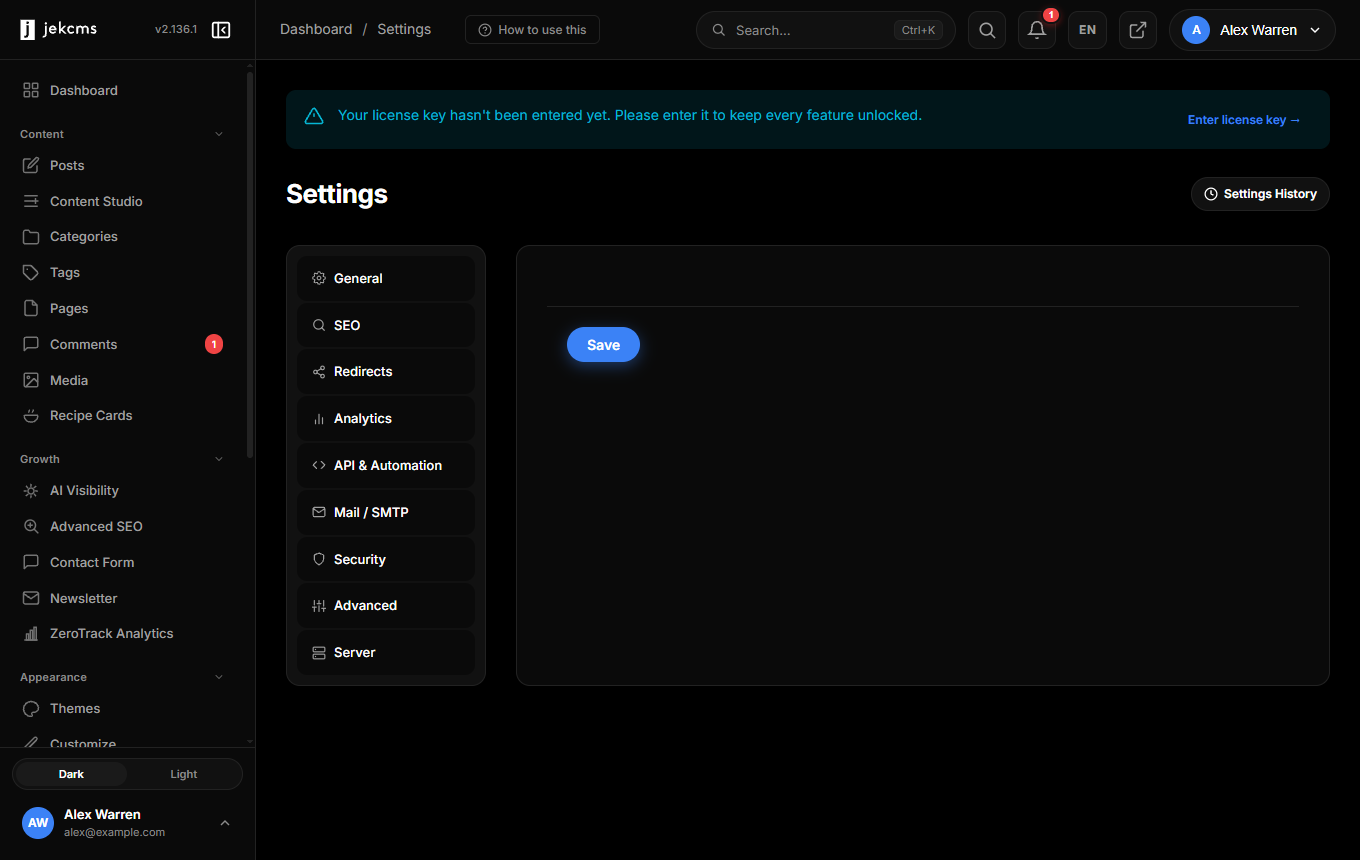
Connecting a provider
Five providers are supported: Gemini, OpenAI, Claude, Groq and Cohere. You need a key from at least one; connecting more than one is useful mainly if you want a fallback.
Keys are encrypted at rest. They are never printed back into a form field - once saved, you see that a key exists, not what it is.
Which model gets used
Every provider offers several models and picking between them is a research task, so jekcms picks a sensible default: the current generation, choosing price and performance over raw capability, because blog-length text does not need a flagship model.
| Provider | Default model | |---|---| | Gemini | gemini-3.8-flash | | OpenAI | gpt-5.6-terra | | Claude | claude-sonnet-5 | | Groq | openai/gpt-oss-120b | | Cohere | command-a-03-2025 |
Each provider's flagship and its cheapest sibling are offered alongside the default, so you can move in either direction without researching model names.
These are read from one registry inside jekcms. When a provider ships a new generation, that file changes and everything else follows - the settings dropdown, the client, the setup wizard and this table.
When a provider is busy
The newest models are the most heavily used ones, and they occasionally answer "high demand" rather than a result. jekcms does not show you that error. The client walks down a chain - current generation, then the stable release, then the last known good one - using the same key and the same request.
What works without a key
Most of jekcms. Writing, publishing, SEO scoring, the health checks, image conversion, imports and everything on the front end are unaffected.
What needs a key is the writing assistance: meta descriptions and titles written for you, alt text generated for images that lack it, the content brief, and bulk runs across many posts at once. Where a feature needs a key and none is connected, jekcms says so plainly and disables the button rather than failing when you press it.
Cost control
Bulk operations run in rounds with a cursor and a wall-clock limit rather than as one long request. A run that stops halfway can be resumed; it does not start over and it does not silently burn a second pass of tokens.
Every AI call is recorded in an audit log with the provider, the model and the task, so a surprising bill can be traced to what caused it.
Related
- Settings Panel - AI settings live under API & Automation
- Bulk AI Generation - running a task across many posts