News Publishers
Getting a site accepted into Google News, Apple News or Microsoft Start is not one submission. It is twenty-two separate applications, each with its own form, its own review queue and its own answer weeks later. The usual way this goes wrong is not rejection — it is losing track of which ones you already sent.
This screen is a register. Every platform gets a card with a status you set yourself, the account URL or channel ID you were given, and a notes field. Nothing here submits an application for you; the platforms have no API for that. What it does is make sure that six weeks from now you still know where each one stands.
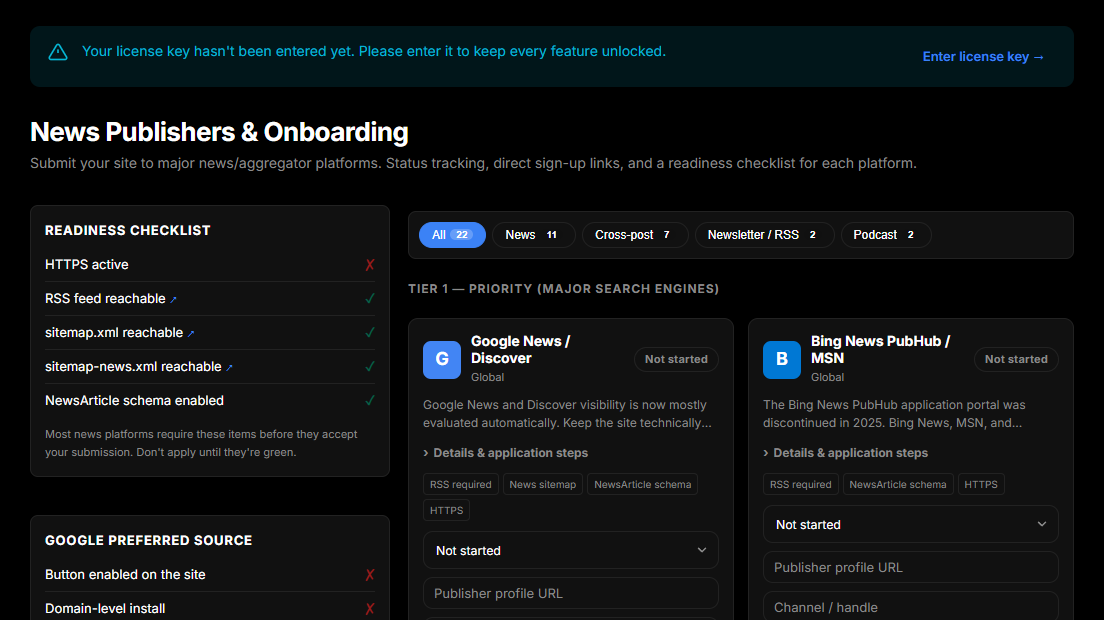
Check readiness before you apply
The panel on the left reads five things from your live site:
| Check | What it looks at | |---|---| | HTTPS active | Whether your site URL is served over HTTPS | | RSS feed reachable | Your feed responds | | sitemap.xml reachable | Your standard sitemap responds | | sitemap-news.xml reachable | The news-specific sitemap responds | | NewsArticle schema enabled | The setting that marks your posts as news articles |
Most news platforms require these before they will accept a submission. A rejection costs you the review window — some platforms ask you to wait months before reapplying — so it is worth waiting until all five are green.
The news sitemap and the NewsArticle schema are the two that are usually missing. Both are switched on in Settings → SEO.
The three tiers
The cards are grouped by how much each platform is likely to be worth to you:
Tier 1 — Priority. Google News, Microsoft Start, Apple News and Flipboard. These are the ones that move traffic. They are also the slowest to review, so start here.
Tier 2 — Expansion. Aggregators and cross-posting destinations: SmartNews, NewsBreak, Techmeme, NewsNow, Substack, Medium, LinkedIn newsletters, dev.to and others. Faster to get into, smaller individually, meaningful in aggregate.
Tier 3 — Community and social. RSS readers (Feedly, Inoreader) and, if you publish audio, the podcast directories (Spotify for Podcasters, Apple Podcasts). Usually a matter of being listed rather than being reviewed.
Each card carries a status you set by hand — Not started, Submitted, Approved, Rejected — because only you know what the platform replied.
Publisher details
Several platforms ask for the same handful of facts during review: a publisher name, a logo, an editorial policy, a corrections policy, an about page and a contact address. The form on the left stores them once.
Two of these have a Create button beside them. If you have no editorial policy or corrections policy page, jekcms will generate one as a draft page on your site so you have something to link. Read it and edit it before you publish — it is a starting point, not a finished policy. Reviewers do read these pages.
A corrections policy is the one publishers most often skip. It states how you fix or retract a post when it turns out to be wrong. News platforms look for it specifically. If you would rather not maintain a separate page, link the relevant section of your editorial policy instead.
Google preferred sources
Separate from the applications, this screen also tracks Google's preferred sources feature. When a reader picks your site as a preferred source in Google Search, your posts carry a badge in Top Stories.
The panel shows whether the button is enabled on your site, whether your install sits at the root of a domain (a site in a subdirectory is not eligible), and how many times the button has been clicked. That click count is ours — Google does not report it.
The button does not make a site eligible. Eligibility follows Google's News content policies and the readiness list above. Use the Search the source tool link to check whether Google already lists your domain.
Related
- Settings → SEO — news sitemap,
NewsArticleschema, robots rules - SEO Status — whether search engines can reach your site at all